

Quick answer
A flat piercing goes through the flat area of cartilage in the upper ear, inside the outer rim. "Flat" is a name piercers use, not a medical term, so the exact spot depends on your ear and your piercer. It’s cartilage, so plan on about 4–12 months to heal (Cleveland Clinic). Rinse with sterile saline 1–3 times a day, keep pressure off it, and leave the jewelry in until it has healed.
Key facts
- Where: the flat part of the upper ear, inside the rim.
- Tissue: cartilage.
- Healing time: about 4–12 months, Cleveland Clinic’s range for ear cartilage. There’s no separate medical figure for the flat.
- Not a medical term: medical sources don’t define a "flat piercing", so we describe it by ear anatomy (NIH).
- Good to know: high ear cartilage piercings are the most common cause of perichondritis, an infection around the cartilage (Cleveland Clinic).
Flat piercing at a glance
- Tissue
- Cartilage
- Where
- The flat area of the upper ear, inside the rim
- Healing time
- About 4–12 months for ear cartilage (Cleveland Clinic)
- First jewelry
- Chosen to fit; implant-grade materials (APP)
- Medical term
- No single one: "flat" is a piercer’s name
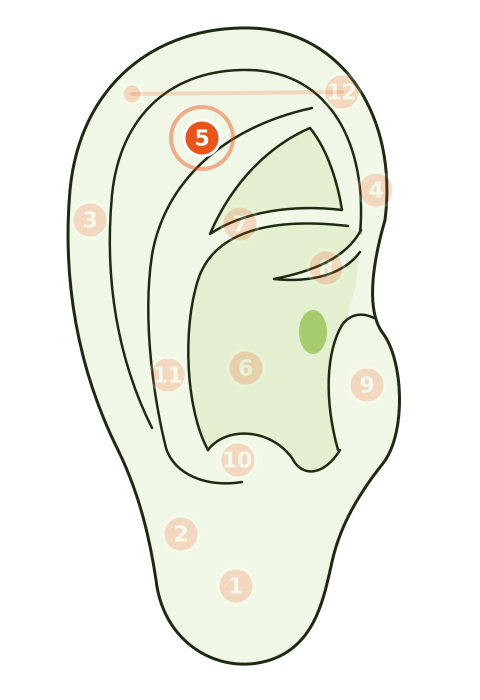
Point 5 of 12 on our ear piercing chart.
Where a flat piercing goes
Look at the top third of your ear. The outer rim is the helix. Inside it runs a second ridge, the antihelix, which splits into two branches near the top. Between the rim and the inner ridge is a groove called the scapha, and between the two branches is a shallow hollow called the triangular fossa (NIH).
A flat piercing sits on the flat, open cartilage in this upper area, inside the rim. Because "flat" isn’t an anatomical term, piercers place it wherever an ear has a smooth, flat surface there. Ears vary a lot (NIH), so your piercer will choose the spot with you.
On our ear piercing chart the flat is point 5, just inside the rim at the top of the ear.
Does a flat piercing hurt?
Usually more than an earlobe: cartilage is thicker and has more nerves (Cleveland Clinic). We don’t publish pain scores: there’s no medical scale for them, and every ear is different.
How long does a flat piercing take to heal?
| Source | Healing time |
|---|---|
| Cleveland Clinic, ear cartilage in general | About 4–12 months |
| Earlobe, for comparison (Cleveland Clinic) | About 6–8 weeks |
There’s no separate medical figure for the flat, so we use the cartilage range. Cartilage has less blood flow than earlobe tissue, which is why it takes longer (APP). It can look healed before it is (APP). It has healed when it doesn’t hurt, isn’t red, swollen or crusty, and the jewelry moves easily (Cleveland Clinic).
Jewelry for a new flat
- Fit first: the jewelry must suit your anatomy and leave room for swelling. Too tight can embed; too loose can snag (APP).
- Style: the APP notes that different placements suit different styles, so your piercer will pick one for your ear.
- Material: implant-grade titanium (ASTM F-136), ASTM F-138 surgical steel, niobium, solid 14K–18K gold that’s nickel- and cadmium-free, platinum, or lead-free glass (APP).
- Skip for now: gold-plated, gold-filled and vermeil jewelry (APP).
- Not with a gun: guns can shatter cartilage and cause serious complications (APP).
Don’t change it until it has fully healed (Cleveland Clinic), and let your piercer make the first change.
Flat piercing aftercare
The routine (APP):
- Wash your hands before you touch it.
- Rinse with sterile saline 1–3 times a day, front and back.
- Pat dry with something disposable, like gauze or a paper towel.
- Leave the jewelry in, and don’t twist it.
What’s different about the flat:
- Pressure from the back: the back of the jewelry sits behind the ear, where glasses arms, hats and headbands press. Adjust them so nothing pushes on it.
- Hair: keep hair products and dry shampoo off it (APP).
- Sleep: don’t sleep on it. A travel pillow with your ear in the opening keeps pressure off (APP).
Bumps and infection
Bumps are common on cartilage piercings: a pustule, a granuloma (which can appear about 6 weeks in), a hypertrophic scar, or a keloid, which grows beyond the piercing (Healthline). A small bump is often irritation from pressure or jewelry fit (NHS, APP). Nickel is the most common metal allergy (DermNet). More in piercing bump: what it is and what to do.
Perichondritis is an infection of the tissue lining the ear cartilage, most often caused by high cartilage piercings. It causes pain, redness, swelling, warmth and sometimes fever, and needs quick treatment to avoid a permanent change in the ear’s shape (Cleveland Clinic).
When to see a doctor
See a doctor if you notice any of these (NHS, Cleveland Clinic, APP):
- swelling, pain or redness that gets worse instead of better;
- skin or the ear that feels hot;
- thick yellow, green or grey discharge, especially if it smells;
- red streaks spreading from the piercing;
- fever, chills, nausea or dizziness;
- a bump that keeps growing beyond the piercing.
Leave your jewelry in unless a doctor tells you otherwise. Removing it during an infection can lead to an abscess (APP, DermNet).
FAQ
What is a flat piercing?
A piercing through the flat area of cartilage in the upper ear, inside the rim. "Flat" is a piercer’s name, not a medical term.
How long does a flat piercing take to heal?
Cleveland Clinic gives about 4–12 months for ear cartilage. There’s no separate figure for the flat.
Is a flat piercing cartilage?
Yes. Everything on the outer ear except the earlobe is cartilage.
What’s the difference between a flat and a helix?
A helix goes through the outer rim. A flat goes through the flat area inside the rim.
Can I sleep on a flat piercing?
Try not to while it heals. Use a travel pillow with your ear in the opening, or sleep on the other side (APP).
Sources
- NIH, Elements of Morphology — Anatomy of the Ear
- Cleveland Clinic — Ear Piercing 101 and Perichondritis
- Healthline — Cartilage Piercing Bump (medically reviewed)
- Association of Professional Piercers — Suggested Aftercare, Jewelry for Initial Piercings and Piercing Guns
- NHS — Infected piercings
- DermNet — Body piercing
This guide is general information. It doesn’t replace advice from your piercer or a healthcare professional.