

Quick answer
An earlobe piercing goes through the fleshy lower part of the ear (Healthline). It’s soft tissue, not cartilage, so it heals much faster: about 6–8 weeks (Cleveland Clinic), or "6 weeks or more" (American Academy of Dermatology). Second, third, upper and stacked lobes are extra holes in the same lobe and heal on the same timeline. Go to a professional piercer, rinse with sterile saline, and keep the earrings in until it has fully healed.
Key facts
- Where: the fleshy, lower part of the ear (Healthline).
- Tissue: soft tissue, not cartilage.
- Healing time: about 6–8 weeks (Cleveland Clinic); "6 weeks or more" (AAD).
- Pain: earlobes usually hurt the least, because they’re fatty tissue with fewer nerves (Cleveland Clinic).
- Lower infection risk than cartilage piercings (Cleveland Clinic).
- Where to go: a professional piercer in a licensed studio (AAD).
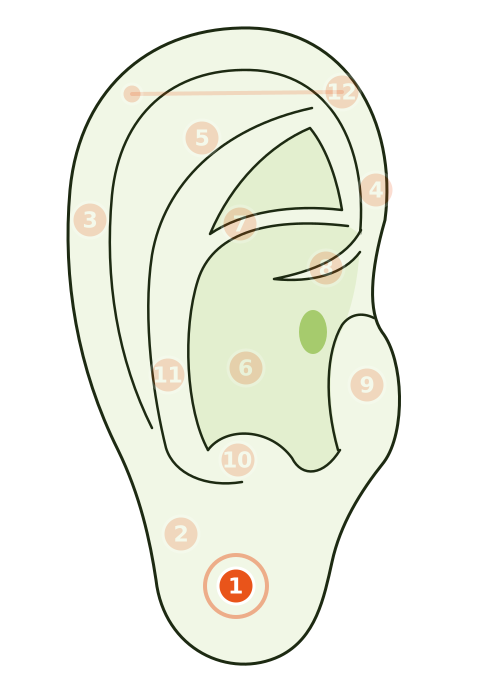
Lobe piercing at a glance
- Tissue
- Soft earlobe tissue, not cartilage
- Where
- The fleshy lower part of the ear (Healthline)
- Healing time
- About 6–8 weeks (Cleveland Clinic); "6 weeks or more" (AAD)
- First jewelry
- Long enough for swelling; implant-grade materials (APP)
- Variations
- Second, third, upper, stacked, transverse lobe
Point 1 of 12 on our ear piercing chart.
Types of lobe piercings
| Name | What it means |
|---|---|
| Lobe (first lobe) | The classic first piercing, through the fleshy lower ear (Healthline) |
| Second and third lobe | Extra holes placed in a line above the first one |
| Upper lobe | A hole high on the lobe, near where it meets the cartilage |
| Stacked lobes | Several holes placed close together on the lobe, often in a curve or cluster |
| Transverse lobe | A horizontal piercing through the earlobe, with the bar running sideways (Healthline) |
All of these go through earlobe tissue, so the earlobe timeline applies. The names other than lobe and transverse lobe are common piercer terms rather than medical ones. How many fit depends on the size of your lobe: earlobes vary a lot in size and shape (NIH), and your piercer will check spacing.
How long does an ear piercing take to heal?
It depends on where it is:
| Piercing | Typical healing time | Source |
|---|---|---|
| Earlobe (first, second, third, upper, stacked) | About 6–8 weeks | Cleveland Clinic; AAD: "6 weeks or more" |
| Ear cartilage (helix, conch, tragus and others) | About 4–12 months | Cleveland Clinic |
Cartilage has less blood flow than earlobe tissue, which is why it takes so much longer (APP). See all 12 placements on our ear piercing chart, or read cartilage piercing: types, healing and infection.
An earlobe can look fine after a couple of weeks while it’s still healing inside (APP). It has healed when it doesn’t hurt, isn’t red, swollen or crusty, and the jewelry moves easily (Cleveland Clinic).
Piercing gun or needle?
The Association of Professional Piercers holds that only sterile, disposable equipment is suitable for body piercing. Its concerns about piercing guns (APP):
- plastic guns can’t be sterilized in an autoclave and may not be cleaned well enough between clients;
- gun studs are too short for some earlobes, and the butterfly clasp can make embedding worse;
- on cartilage, guns can cause serious problems, including shattered cartilage.
The AAD recommends a professional piercer in a licensed studio. If you’re choosing, ask whether the studio uses a sterile, single-use needle and implant-grade jewelry.
Jewelry for a new lobe piercing
- Length: long enough for swelling. Jewelry that’s too tight can embed (APP).
- Material: implant-grade titanium (ASTM F-136), ASTM F-138 surgical steel, niobium, solid 14K–18K gold that’s nickel- and cadmium-free, platinum, or lead-free glass (APP).
- Skip for now: gold-plated, gold-filled and vermeil jewelry; the thin gold layer can wear off (APP).
- Nickel: it’s the most common metal allergy (DermNet), so check what your first earrings are made of.
When can I change my earrings?
Not until the piercing has fully healed (Cleveland Clinic). For an earlobe that’s usually 6–8 weeks or more. Take earrings out too early and the hole can start to close (AAD, Cleveland Clinic). If the post needs to be shortened once the swelling goes down, your piercer should do it (APP).
Earlobe piercing aftercare
The routine (APP):
- Wash your hands before you touch it.
- Rinse with sterile saline 1–3 times a day, front and back.
- Pat dry with something disposable, like gauze or a paper towel.
- Leave the earrings in, and don’t twist them.
Earlobe tips:
- Phone and hair: keep your phone clean and watch for hair and clothing snagging (APP).
- Sleep: keep pillowcases clean, or pull a clean T-shirt over the pillow and flip it each night (APP).
- Turning the earring: most professional piercers now say not to (APP). Some medical sources still suggest turning it gently while cleaning (NHS, Cleveland Clinic). If your piercer gave you instructions, follow them.
Infected earlobe piercing: what to look for
Some redness, swelling, tenderness and a light crust are normal in the first weeks (APP, NHS). Warning signs are different: pain, swelling or redness that keeps getting worse, skin that feels hot, thick yellow, green or grey discharge, or a fever (NHS, Cleveland Clinic). Compare yours with infected or irritated: how to tell.
Perichondritis, the cartilage infection, doesn’t affect the earlobe (Cleveland Clinic). A bump on a lobe can be irritation or, more rarely, a keloid that keeps growing; that needs a doctor. More in piercing bump: what it is and what to do.
When to see a doctor
See a doctor if you notice any of these (NHS, Cleveland Clinic, APP):
- swelling, pain or redness that gets worse instead of better;
- skin that feels hot;
- thick yellow, green or grey discharge, especially if it smells;
- red streaks spreading from the piercing;
- fever, chills, nausea or dizziness;
- a bump that keeps growing beyond the piercing;
- an earring back that’s sinking into the skin.
Leave your earrings in unless a doctor tells you otherwise. Removing them during an infection can lead to an abscess (APP, DermNet).
FAQ
How long does an ear piercing take to heal?
An earlobe takes about 6–8 weeks (Cleveland Clinic). Ear cartilage takes about 4–12 months.
How long does a second or third lobe piercing take to heal?
The same as the first: about 6–8 weeks, because it’s the same earlobe tissue (Cleveland Clinic).
What is a stacked lobe piercing?
Several holes placed close together on the earlobe. How many fit depends on your lobe; your piercer will check spacing.
What is a transverse lobe piercing?
A horizontal piercing through the earlobe (Healthline).
Is a piercing gun or a needle better for earlobes?
The APP recommends sterile, single-use equipment and raises concerns about guns, including cleaning and stud length. The AAD recommends a professional piercer in a licensed studio.
When can I change my earrings after a lobe piercing?
Once it has fully healed, usually 6–8 weeks or more (Cleveland Clinic, AAD).
Can I sleep on a new earlobe piercing?
Try to sleep on the other side, keep pillowcases clean, and use a clean T-shirt over the pillow (APP).
Sources
- Cleveland Clinic — Ear Piercing 101, Infected Ear Piercing and Perichondritis
- American Academy of Dermatology — Caring for pierced ears
- Healthline — Daith Piercing Pain (placements; medically reviewed)
- NIH, Elements of Morphology — Anatomy of the Ear
- Association of Professional Piercers — Suggested Aftercare, Jewelry for Initial Piercings and Piercing Guns
- NHS — Infected piercings
- DermNet — Body piercing
This guide is general information. It doesn’t replace advice from your piercer or a healthcare professional.