

Quick answer
There are 12 common ear piercings. Two are in the soft earlobe: the lobe and the upper lobe. The other ten go through cartilage: helix, forward helix, flat, conch, rook, daith, tragus, anti-tragus, snug and industrial. Earlobe piercings usually heal in about 6–8 weeks. Cartilage piercings take longer, about 4–12 months, because cartilage gets less blood supply (Cleveland Clinic).
Key facts
- 12 common placements: 2 in the earlobe, 10 in cartilage.
- Earlobe: about 6–8 weeks to heal (Cleveland Clinic).
- Cartilage: about 4–12 months; for daith, rook, conch, helix and tragus, Cleveland Clinic’s ear piercing guide says 6–12 months.
- Why the difference: cartilage gets less blood supply than soft tissue, so it heals slowly (Cleveland Clinic).
- Pain: earlobes usually hurt the least; cartilage is thicker and has more nerves (Cleveland Clinic).
- Same aftercare for all of them: sterile saline, clean hands, no twisting (APP).
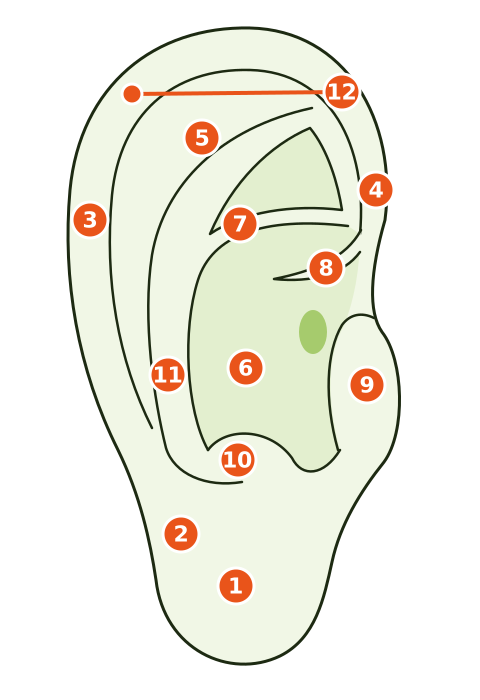
Ear piercing chart
- 1 Lobe Earlobe
- 2 Upper lobe Earlobe
- 3 Helix Cartilage
- 4 Forward helix Cartilage
- 5 Flat Cartilage
- 6 Conch Cartilage
- 7 Rook Cartilage
- 8 Daith Cartilage
- 9 Tragus Cartilage
- 10 Anti-tragus Cartilage
- 11 Snug Cartilage
- 12 Industrial Cartilage
Earlobe: about 6–8 weeks to heal. Cartilage: about 4–12 months (Cleveland Clinic).
Ear piercing names at a glance
| # | Piercing | Where it is | Tissue | Typical healing time |
|---|---|---|---|---|
| 1 | Lobe | The fleshy lower part of the ear | Earlobe | 6–8 weeks |
| 2 | Upper lobe | A second or third hole higher up on the earlobe | Earlobe | 6–8 weeks |
| 3 | Helix | The outer, thin upper rim of the ear | Cartilage | 6–12 months |
| 4 | Forward helix | The front of the upper rim, where the ear meets the head | Cartilage | 4–12 months |
| 5 | Flat | The flat area of the upper ear, inside the rim | Cartilage | 4–12 months |
| 6 | Conch | The "cup" of the ear | Cartilage | 6–12 months |
| 7 | Rook | The fold of cartilage above the daith | Cartilage | 6–12 months |
| 8 | Daith | The fold where the rim ends, just above the ear canal | Cartilage | 6–12 months |
| 9 | Tragus | The small flap of cartilage in front of the ear canal | Cartilage | 6–12 months |
| 10 | Anti-tragus | The bump of cartilage across from the tragus, above the lobe | Cartilage | 4–12 months |
| 11 | Snug | The inner ridge of cartilage inside the rim | Cartilage | 4–12 months |
| 12 | Industrial | Two holes in the upper ear joined by one long bar | Cartilage | 4–12 months |
Healing times: Cleveland Clinic. The 6–12 month range is Cleveland Clinic’s figure for daith, rook, conch, helix and tragus; 4–12 months is its range for ear cartilage in general. Your own timeline depends on your health, the jewelry, the piercing method and the placement (Cleveland Clinic). Your piercer can tell you when yours has healed.
Lobe piercings
Lobe. The classic first piercing, through the fleshy lower part of the ear (Healthline). Earlobes are fatty tissue with fewer nerves, so they usually hurt the least, and they heal in about 6–8 weeks (Cleveland Clinic).
Upper lobe. A second or third hole placed higher on the earlobe. It’s still earlobe tissue, so the earlobe timeline applies. Your piercer will check there’s enough room between holes.
Also seen: the transverse lobe, a horizontal piercing through the earlobe (Healthline).
Upper ear: helix, forward helix, flat and industrial
Helix. A piercing through the outer, thin upper part of the ear (Healthline). It’s one of the most popular cartilage piercings, and one of the slowest to heal: about 6–12 months (Cleveland Clinic). More in how long a helix piercing takes to heal. Full guide: helix piercing.
Forward helix. The inner, front part of the upper rim, close to where the ear meets your face (Healthline). Like every cartilage piercing, plan on months, not weeks.
Flat. A piercing in the flat area of the upper ear, between the outer rim and the inner ridge. It’s cartilage, so the cartilage timeline applies.
Industrial. Two piercings through the top fold of the ear (Healthline), worn with one long bar. Because it’s two cartilage holes, keep pressure and snagging off it while both heal. Full guide: industrial piercing.
Inner ear: conch, rook, daith and snug
Conch. The "cup" of the ear (Healthline). An inner conch sits higher, parallel to the daith; an outer conch is lower, closer to the outer ridge (Healthline). Healing: about 6–12 months (Cleveland Clinic). Full guide: conch piercing.
Rook. An inner ear piercing in the upper part of the ear, on the fold of cartilage above the daith (Cleveland Clinic, Healthline). Healing: about 6–12 months (Cleveland Clinic). Full guide: rook piercing.
Daith. A piercing where the cartilage ridge of the rim ends, just above the opening of the ear canal (Cleveland Clinic). Healing: about 6–12 months (Cleveland Clinic). You may have heard that a daith piercing helps with migraines: Cleveland Clinic says there’s no evidence that it does. Full guide: daith piercing.
Snug. The central vertical fold of cartilage inside the rim (Healthline). Cartilage timeline: months, not weeks.
Also seen: the orbital, placed around the central vertical fold of cartilage inside the rim (Healthline).
Near the ear canal: tragus and anti-tragus
Tragus. The small piece of cartilage at the entrance of the ear canal, where the ear meets the face (Cleveland Clinic, Healthline). Healing: about 6–12 months (Cleveland Clinic). Keep earbuds, headphones and your phone clean (APP), and try not to press them on it while it heals. Full guide: tragus piercing.
Anti-tragus. The bump of cartilage across from the tragus, just above the earlobe (Healthline). Cartilage timeline applies.
Lobe vs cartilage: why it matters
More detail in our guides to earlobe piercings and cartilage piercings.
- Healing time. Earlobes heal in about 6–8 weeks; cartilage takes about 4–12 months. Cartilage gets less blood supply, so it repairs itself slowly (Cleveland Clinic).
- Infections. Infections in ear cartilage are more likely and can be more serious than in the earlobe, so a doctor should check any warning signs promptly (Cleveland Clinic).
- Pressure. Sleeping on a healing cartilage piercing can irritate it and even shift its angle. A travel pillow with your ear in the opening helps (APP).
- Looks can fool you. A piercing heals from the outside in, so it can look healed before it is (APP).
Signs your ear piercing has healed
Cleveland Clinic lists these signs:
- it doesn’t hurt;
- it isn’t red or swollen;
- it isn’t crusty, scabby or flaking;
- you can move the jewelry easily.
Don’t change your earrings until the piercing has fully healed (Cleveland Clinic). If the post needs to be shortened once the swelling goes down, your piercer should do it (APP).
Choosing jewelry
When it’s time to change earrings, choose hypoallergenic metals without nickel alloys (Cleveland Clinic). Nickel is the most common metal allergy (DermNet). The safer choices Cleveland Clinic lists:
- 14K gold;
- medical-grade steel;
- titanium.
Aftercare for any ear piercing
The routine is the same for every placement on this chart (APP):
- Wash your hands before you touch the piercing.
- Rinse it with sterile saline 1–3 times a day, front and back.
- Pat dry with something disposable, like gauze or a paper towel.
- Leave the jewelry in, and don’t twist it.
The full routine is in how to clean a piercing, and the bigger picture is in our complete piercing aftercare guide.
When to see a doctor
See a doctor if you notice any of these (NHS, Cleveland Clinic, APP):
- swelling, pain or redness that gets worse instead of better;
- skin that feels hot;
- thick yellow, green or grey discharge, especially if it smells;
- red streaks spreading from the piercing;
- fever, chills, nausea or dizziness;
- any of these on ear cartilage, where infections can be more serious (Cleveland Clinic).
Leave your jewelry in unless a doctor tells you otherwise. Removing it during an infection can lead to an abscess (APP, DermNet). More in infected or irritated: how to tell.
FAQ
What are the different types of ear piercings?
The common ones are lobe, upper lobe, helix, forward helix, flat, conch, rook, daith, tragus, anti-tragus, snug and industrial. Lobe and upper lobe go through soft tissue; the rest go through cartilage.
What is the least painful ear piercing?
Usually the earlobe. It’s fatty tissue with fewer nerves; cartilage is thicker and has more nerves (Cleveland Clinic).
Which ear piercing heals the fastest?
The earlobe, in about 6–8 weeks. Cartilage piercings take about 4–12 months (Cleveland Clinic).
What is a daith piercing?
A piercing through the fold of cartilage where the ear’s rim ends, just above the ear canal (Cleveland Clinic).
Does a daith piercing help with migraines?
Cleveland Clinic says there’s no evidence that a daith piercing helps with migraines.
Which ear piercings are cartilage?
Everything except the lobe and upper lobe: helix, forward helix, flat, conch, rook, daith, tragus, anti-tragus, snug and industrial.
When can I change my cartilage earring?
Only after it has fully healed, which can take up to a year (Cleveland Clinic). Ask your piercer to check it first.
Sources
- Cleveland Clinic — Ear Piercing 101: Healing, Hurting, Cleaning and More, Infected Ear Piercing and Can a Daith Piercing Prevent Migraines?
- Healthline — Daith Piercing Pain: What to Expect (medically reviewed) and Conch Piercing
- Association of Professional Piercers — Suggested Aftercare and Aftercare for minors
- NHS — Infected piercings
- DermNet — Body piercing
This guide is general information. It doesn’t replace advice from your piercer or a healthcare professional.