

Quick answer
A helix piercing goes through the outer, thin upper rim of the ear (Healthline). It’s a cartilage piercing, so it heals much more slowly than an earlobe: about 6–12 months (Cleveland Clinic). Start with implant-grade titanium, ASTM F-138 steel, niobium or solid 14K+ gold (APP). Rinse it with sterile saline 1–3 times a day, keep pressure off it, and leave the jewelry in until it has fully healed.
Key facts
- Where: the outer, thin upper part of the ear (Healthline).
- Tissue: cartilage.
- Healing time: about 6–12 months (Cleveland Clinic).
- Pain: usually more than an earlobe, because cartilage is thicker and has more nerves (Cleveland Clinic).
- Good to know: infections in ear cartilage are more likely and can be more serious than in the earlobe (Cleveland Clinic).
- Biggest everyday problem: pressure and snagging from sleeping, hair, headphones and clothing (APP).
Helix piercing at a glance
- Tissue
- Cartilage
- Where
- The outer, thin upper rim of the ear (Healthline)
- Healing time
- About 6–12 months (Cleveland Clinic)
- First jewelry
- Implant-grade titanium, ASTM F-138 steel, niobium or solid 14K+ gold (APP)
- Variations
- Double helix, triple helix
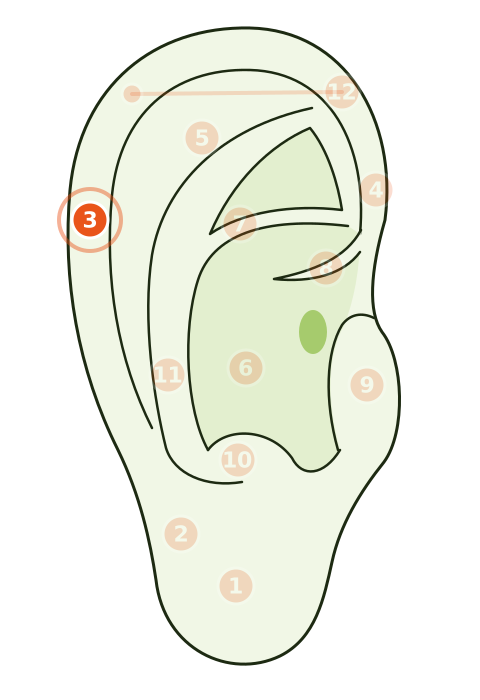
Point 3 of 12 on our ear piercing chart.
Where a helix piercing goes
The helix is the curved outer rim at the top of your ear, and a helix piercing goes through that thin edge of cartilage (Healthline). It’s one of the most common first cartilage piercings.
- Forward helix is a different placement: the front of the upper rim, close to where the ear meets your face (Healthline).
- Double and triple helix are two or three helix piercings placed one above another along the rim. Each hole is its own cartilage wound with its own full healing time, so ask your piercer about spacing and whether to do them at once.
- Industrial uses two holes in the upper ear joined by one long bar (Healthline). It has its own guide.
Does a helix piercing hurt?
Most people find it hurts more than an earlobe. Earlobes are soft tissue with fewer nerves, while cartilage is thicker and has more nerves (Cleveland Clinic).
We don’t publish pain scores. There’s no medical scale for them, and every ear and every person is different. Your piercer can tell you what to expect for your anatomy.
How long does a helix piercing take to heal?
| Source | Healing time |
|---|---|
| Cleveland Clinic, for the helix | About 6–12 months |
| Cleveland Clinic, for ear cartilage in general | About 4–12 months |
| Earlobe, for comparison (Cleveland Clinic) | About 6–8 weeks |
A piercing heals from the outside in, so a helix can look calm months before it has healed inside (APP). It has healed when it doesn’t hurt, isn’t red, swollen or crusty, and the jewelry moves easily (Cleveland Clinic).
What’s normal from week to week, and how to sleep on it, is in how long a helix piercing takes to heal.
Jewelry for a new helix
Your first piece of jewelry sits inside a fresh wound, so safety comes before looks (APP):
- Size: long enough for swelling and right for your anatomy. Jewelry that’s too tight can embed; too loose can snag (APP).
- Material: implant-grade titanium (ASTM F-136), ASTM F-138 surgical steel, niobium, solid 14K–18K gold that’s nickel- and cadmium-free, platinum, or lead-free glass (APP).
- Skip for now: gold-plated, gold-filled and vermeil jewelry. The thin gold layer can wear off (APP).
- Threading: internally threaded or threadless, so no rough screw threads pass through the piercing (APP).
Want a hoop or a new stud? Don’t change it until the piercing has fully healed (Cleveland Clinic), and let your piercer do the first change. If the post needs to be shortened once the swelling goes down, your piercer should do that too (APP).
Helix aftercare
The routine is the same as for any piercing (APP):
- Wash your hands before you touch it.
- Rinse with sterile saline 1–3 times a day, front and back.
- Pat dry with something disposable, like gauze or a paper towel.
- Leave the jewelry in, and don’t twist it.
What’s different about the helix is where it sits:
- Sleep: don’t sleep on it. A travel pillow with your ear in the opening keeps pressure off (APP).
- Hair: keep hair products and dry shampoo off it (APP). Piercings high on the ear sit close to your hair, which is one reason they’re more prone to infection (Healthline).
- Headphones, hats and phones: anything that presses on the rim can irritate it; keep phones and headphones clean (APP).
Bumps on a helix piercing
Bumps are common on cartilage piercings. Healthline lists four kinds: a pustule (a pimple with pus), a granuloma (a lesion that can show up about 6 weeks after piercing), a hypertrophic scar, and a keloid, which grows beyond the piercing. Causes include allergies, genetics and aftercare (Healthline).
A small bump next to the hole is often irritation, not a keloid (NHS). The usual triggers are pressure, snagging, the wrong aftercare, and jewelry that doesn’t fit or that your skin reacts to (APP). Nickel is the most common metal allergy (DermNet). Changing the jewelry often helps, so let a piercer look (APP). More in piercing bump: what it is and what to do.
When to see a doctor
See a doctor if you notice any of these (NHS, Cleveland Clinic, APP):
- swelling, pain or redness that gets worse instead of better;
- skin that feels hot;
- thick yellow, green or grey discharge, especially if it smells;
- red streaks spreading from the piercing;
- fever, chills, nausea or dizziness;
- a bump that keeps growing beyond the piercing.
Don’t wait on a helix: infections in ear cartilage can be more serious (Cleveland Clinic). Leave your jewelry in unless a doctor tells you otherwise. Removing it during an infection can lead to an abscess (APP, DermNet).
FAQ
What is a helix piercing?
A piercing through the outer, thin upper rim of the ear (Healthline). It goes through cartilage.
How long does a helix piercing take to heal?
About 6–12 months, according to Cleveland Clinic. It can look healed sooner, so keep up aftercare until it’s fully healed.
What’s the difference between a helix and a forward helix?
A helix is on the outer upper rim. A forward helix is on the front of the rim, close to your face (Healthline).
What is a double helix piercing?
Two helix piercings, one above the other, on the upper rim. Each hole heals on its own cartilage timeline.
Can I sleep on my helix piercing?
Try not to while it heals. Use a travel pillow with your ear in the opening, or sleep on the other side (APP).
When can I put a hoop in my helix?
Only after it has fully healed (Cleveland Clinic). Ask your piercer to check it and make the first change.
Do helix piercings get infected easily?
Infections are more likely, and can be more serious, in ear cartilage than in the earlobe (Cleveland Clinic). Clean hands, sterile saline and no pressure help. See a doctor if you notice warning signs.
Sources
- Cleveland Clinic — Ear Piercing 101: Healing, Hurting, Cleaning and More and Infected Ear Piercing
- Healthline — Daith Piercing Pain: What to Expect (placements; medically reviewed), Cartilage Piercing Bump (medically reviewed) and Industrial Piercing Infection (medically reviewed)
- Association of Professional Piercers — Suggested Aftercare and Jewelry for Initial Piercings
- NHS — Infected piercings
- DermNet — Body piercing
This guide is general information. It doesn’t replace advice from your piercer or a healthcare professional.